The recent United States election is historic, controversial, and "roller coastery" to say the least! Donald John Trump became victorious, but some community organizers and environmental justice advocates are unhappy and frightened by what a Trump Administration might mean for the country's environment and public health. Several confirmed and potential Cabinet picks are quite alarming. As the current Attorney General of Oklahoma, Scott Pruitt sued the Environmental Protection Agency (EPA) a couple of times unsuccessfully in objection to "burdensome" regulations. Ironically, the generally anti-EPA Pruitt is expected to be President-elect Trump's Administrator to the EPA. Exxon CEO Rex Tillerson may be Trump's Secretary of State. You and I might conjecture that the impact of climate change around the world as well as the importance of environmental justice around the world will not be issues of concern for Tillerson. Tillerson (if chosen) and Pruitt will require the Senate's advise and consent, meaning a formal questions-and-answers process to determine if they will be fit for carrying out their duties.
Also, could the Trump transition team's questionnaire (New York Times) — a list of 74 Department of Energy wide-ranging questions delivered to Dept. of Energy officials — indicate an interest in "efforts to promote nuclear power" as well as undermine research related to protecting the environment? As Nuclear Waste Concerns discussed in multiple posts, promoting a stronger reliance on nuclear power could lead to more radioactive waste being disposed in locations where environmental injustice against underprivileged populations (especially impoverished, Native-American, and African-American people) is an alarming concern for many activists and underprivileged people. Two questions from the Trump transition team stood out to me, considering that they pertain to a topic I previously discussed:
28. Are there statutory restrictions related to reinvigorating the Office of Civilian Radioactive Waste Management (OCRWM)?
29. Are there any statutory restrictions [against] restarting the Yucca Mountain project?
The colloquially named Yucca Mountain project refers to a proposed nuclear waste storage site in southern Nevada. Managed and supervised by the Office of Civilian Radioactive Waste Management, this controversial project was temporarily stopped and defunded by the Obama administration. Officials took into consideration the health concerns that might affect Western Shoshone Native Americans and also wondered if that site was safely capable of holding the country's nuclear waste. Retiring Senator Harry Reid vocally criticized the Yucca Mountain project. Did the Trump team know about Reid's strong stance against this site? Do they therefore hope this projection gets a second chance, given that Reid will retire? Trump's future presidency is arguably a case of "only time will tell." We would have to wait until his presidency actually starts in order to truly understand the consequences of his administration's policies and actions. In the meantime, though, environmental justice advocates will need to revitalize, organize, and support the organizations, activities, and actions related to environmental justice, making sure we "hold Trump's feet to the fire" so that the next administration will think about everyone in their decisions. It is unfortunate to realize that Dr. Jill Stein, Green Party candidate for President, was the only after-Primary candidate to (1) visit Standing Rock* in solidarity with Native American protestors and (2) talk about the importance of remedying environmental injustice and environmental racism concerns.
* If you hadn't heard, this was the site for an extremely controversial Dakota Access pipeline, which has been halted for now until other sites are considered for evaluation.
Showing posts with label nuclear waste. Show all posts
Showing posts with label nuclear waste. Show all posts
Sunday, December 11, 2016

Thursday, April 28, 2016
The Dangers of Nuclear Waste (A Snapshot)
Nuclear power has long since been considered a great way to generate massive amounts of electricity without emitting any greenhouse gas pollution. However, the rare nuclear disaster poses a rather significant threat to humans and the environment to which it is exposed. The storage of nuclear, or radioactive waste can also be cause for concern about health and safety of the general public. Nuclear power operations have become more strict over the years, but tons of hazardous waste materials are produced every year, which is difficult to transport and shift around. Despite tight efforts to keep nuclear disasters at a minimum, nuclear waste still poses many dangers. Storage containers made of steel and concrete are designed to keep nuclear waste from leaking out and harming anything in the vicinity, however, there are other dangers are involved in the storing of radioactive materials.
1. Long half life: The products of nuclear fission have long half lives, meaning the bi-products will continue to emit radiation for a long, long time to come. We're talking thousands of years! If anything were to happen to the storage container, a nuclear facility would have a dangerous radioactive leak on their hands.
2. Storage: As mentioned in previous blog posts, storing methods in themselves pose a threat of a nuclear waste mishap. The steel and concrete storage cells are relatively cheap and are stored out in the open air. If one were to be punctured, the radiation would already be exposed to the surrounding environment. Cooling pools are not exempt from the worries, as you will notice by referring to post Safer Storage for Spent Nuclear Fuel Rods.
3. Effects on Nature: Generally, the huge steel and concrete drums are purported to safely seal in radioactive material, but when leaks occur, effects can be extremely hazardous to plant and animal life. Side-effects can include cancerous growths or genetic mutations that may be present for many generations following exposure.
4. Human Health Effects: Arguably the most important concern of improper radioactive waste disposal are the negative effects that it can have on the human body when exposed to radiation. Immediate effects of exposure include rapid sickness, such as headaches and vomiting, while long term effects can cause cancer, benign tumors, cataracts, and even death. Other issues involved with nuclear disposal accidents can be observed in historical accidents, such as Chernobyl, where an entire town was evacuated and is still off limits to this day. Monetary expenses are also a big concern when considering clean up of any degree of nuclear exposure.
1. Long half life: The products of nuclear fission have long half lives, meaning the bi-products will continue to emit radiation for a long, long time to come. We're talking thousands of years! If anything were to happen to the storage container, a nuclear facility would have a dangerous radioactive leak on their hands.
2. Storage: As mentioned in previous blog posts, storing methods in themselves pose a threat of a nuclear waste mishap. The steel and concrete storage cells are relatively cheap and are stored out in the open air. If one were to be punctured, the radiation would already be exposed to the surrounding environment. Cooling pools are not exempt from the worries, as you will notice by referring to post Safer Storage for Spent Nuclear Fuel Rods.
3. Effects on Nature: Generally, the huge steel and concrete drums are purported to safely seal in radioactive material, but when leaks occur, effects can be extremely hazardous to plant and animal life. Side-effects can include cancerous growths or genetic mutations that may be present for many generations following exposure.
4. Human Health Effects: Arguably the most important concern of improper radioactive waste disposal are the negative effects that it can have on the human body when exposed to radiation. Immediate effects of exposure include rapid sickness, such as headaches and vomiting, while long term effects can cause cancer, benign tumors, cataracts, and even death. Other issues involved with nuclear disposal accidents can be observed in historical accidents, such as Chernobyl, where an entire town was evacuated and is still off limits to this day. Monetary expenses are also a big concern when considering clean up of any degree of nuclear exposure.
Sunday, April 17, 2016
The Nuclear Waste Dump
It was in 1980 the government of Taiwan build a fish cannery with its own port facilities in the point of Orchid Island. This was supposed to be a project that would be beneficial for the local people as it would provide employment. But soon after its installment, in 1982, Taipower, began shipping nuclear waste barrels from the three nuclear plants in Taiwan. Three story down, it has the capacity to hold upto 100,000 barrels.
This so called safe storage facility has deformed fish and other biological. Some have also reported to see broken barrels being dumped in the hills! These careless activities have led to several cases of cancer with also resulted in deaths. The government has tired its best to bury the bodies before the autopsy could be done and the actual cause of the dame to be proved. As much as 50 newborn babies have been formed with deformities and this shows that the infection from the plan is contagious.
Several protests have been done in the past and youth organizations have bee formed. Tao youth organization was also one of the major anti-nuclear organization in the nation. Due to their efforts, in 1994, there was a ban imposed on the shipment of the nuclear barrels. However, there were already 97,000 barrels in the storage unit. The government has sanctioned $10 million to the Orchid Island community that was effected by the effect of this leftover waste but due to corrupt officials and most of the money does not reach its destined location. The indigenous people not only have to fight for their rights for environmental justice, but also the corrupt governing body that does not allow much reformation to take place. Even though there is some hope, for a major change to be seen in the nuclear safety, changes have to be made in the governing body itself.

It was in 1980 the government of Taiwan build a fish cannery with its own port facilities in the point of Orchid Island. This was supposed to be a project that would be beneficial for the local people as it would provide employment. But soon after its installment, in 1982, Taipower, began shipping nuclear waste barrels from the three nuclear plants in Taiwan. Three story down, it has the capacity to hold upto 100,000 barrels.
This so called safe storage facility has deformed fish and other biological. Some have also reported to see broken barrels being dumped in the hills! These careless activities have led to several cases of cancer with also resulted in deaths. The government has tired its best to bury the bodies before the autopsy could be done and the actual cause of the dame to be proved. As much as 50 newborn babies have been formed with deformities and this shows that the infection from the plan is contagious.
Several protests have been done in the past and youth organizations have bee formed. Tao youth organization was also one of the major anti-nuclear organization in the nation. Due to their efforts, in 1994, there was a ban imposed on the shipment of the nuclear barrels. However, there were already 97,000 barrels in the storage unit. The government has sanctioned $10 million to the Orchid Island community that was effected by the effect of this leftover waste but due to corrupt officials and most of the money does not reach its destined location. The indigenous people not only have to fight for their rights for environmental justice, but also the corrupt governing body that does not allow much reformation to take place. Even though there is some hope, for a major change to be seen in the nuclear safety, changes have to be made in the governing body itself.
Friday, April 15, 2016
This Month in Nuclear History
On April 26, 1986, the infamous and catastrophic Chernobyl nuclear accident occurred. 28 years later, the world still remembers the worst-ever nuclear disaster when the Chernobyl power plant blew up as a result of faulty designs and subpar attendant training.
On April 25, a routine shutdown was conducted in preparation of a technical experiment that would theoretically determine how long the turbines would spin and supply power. As this experiment was previously attempted a year prior, new voltage regulator designs were going to be tested in conjunction.
By the time the nuclear operator went to shut down Reactor No. 4 was extremely unstable, resulting in a power surge that consequently led to fuel fragmentation, vessel rupture, and a series of steam explosions. The explosions and fire that followed the meltdown released massive amounts of radioactive material into the environment. Immediate actions to curb the fire and nuclear leaks included pouring sand and boron on to the reactor via helicopter.
Three kilometers away, the city of Pripyat evacuated 50,000 residents following the nuclear meltdown, and a radius of 30 kilometers was closed off by officials, totaling 115,000 people. Another 220,000 people were evacuated in subsequent years.
Within weeks, workers coated Reactor No. 4 in a temporary concrete "sarcophagus" to limit further release of radioactive material. Despite attempts to prevent this, Reactor No. 4 continued to leak fumes of contaminated waste. Four times more radioactive material was released for Chernobyl than by the atomic bombing of Hiroshima. Large quantities of radioactive material was released into the air for about 10 days.
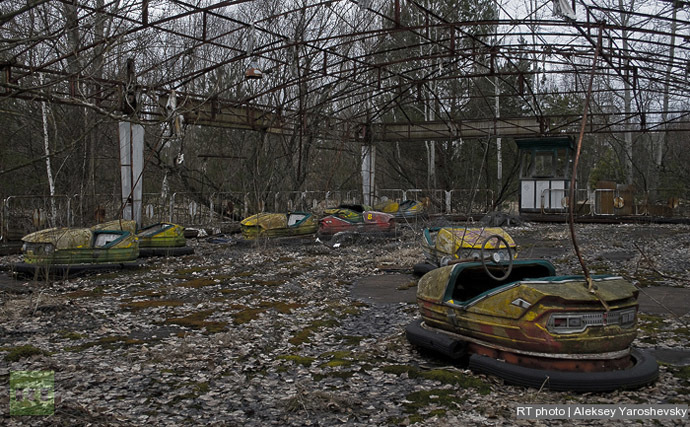
 This image depicts the Chernobyl nuclear power plant's fourth reactor in this May 1986 file photo. (Reuters)
The following months accounted for 28 deaths in all, two from the explosions themselves, the others from excessive exposure to radiation. To date, about 6,000 cases of thyroid cancer had been diagnosed in children who were exposed to the radiation from the meltdown. Many residents in Pripyat prior to the massive evacuation reported symptoms of radiation exposure, including migraines and a metallic taste in their mouths.
As for the surrounding environment, rivers, lakes, reservoirs, and flora and fauna suffered damaging effects as a result of the nuclear meltdown. Water sources in the affected areas of the Ukraine had levels of radiation that were cause for concern for months afterwards. Concentrations in fish were so high that they were unfit for consumption. However, groundwater was not affected nearly as badly since the majority of radionuclides decayed in the soil above long before it reached the water table. Animals in the worst hit areas either died or stopped reproducing. Livestock as far as northern Europe were required to take uncontaminated feed for a period before slaughter to ensure safe consumption.
The after-effects of Chernobyl were expected to be seen for upwards of 100 years following the disastrous meltdown of the Ukraine nuclear power plant. Economic expenses for containment and decontamination were equivalent to $18 billion dollars. The damaged reactor was sealed off with 200 cubic meters of concrete, and the entire facility was completely shut down on December 15, 2000, following the shutdown of the last operation reactor. The nearby town of Pripyat is still abandoned to this day as a result of the extreme radiation levels that contaminated the area.
Citations — Literary Sources
https://www.rt.com/news/155072-chernobyl-images-now-then/
http://www.nrc.gov/reading-rm/doc-collections/fact-sheets/chernobyl-bg.html
http://www.world-nuclear.org/information-library/safety-and-security/safety-of-plants/chernobyl-accident.aspx
On April 25, a routine shutdown was conducted in preparation of a technical experiment that would theoretically determine how long the turbines would spin and supply power. As this experiment was previously attempted a year prior, new voltage regulator designs were going to be tested in conjunction.
By the time the nuclear operator went to shut down Reactor No. 4 was extremely unstable, resulting in a power surge that consequently led to fuel fragmentation, vessel rupture, and a series of steam explosions. The explosions and fire that followed the meltdown released massive amounts of radioactive material into the environment. Immediate actions to curb the fire and nuclear leaks included pouring sand and boron on to the reactor via helicopter.
Three kilometers away, the city of Pripyat evacuated 50,000 residents following the nuclear meltdown, and a radius of 30 kilometers was closed off by officials, totaling 115,000 people. Another 220,000 people were evacuated in subsequent years.
Within weeks, workers coated Reactor No. 4 in a temporary concrete "sarcophagus" to limit further release of radioactive material. Despite attempts to prevent this, Reactor No. 4 continued to leak fumes of contaminated waste. Four times more radioactive material was released for Chernobyl than by the atomic bombing of Hiroshima. Large quantities of radioactive material was released into the air for about 10 days.
The following months accounted for 28 deaths in all, two from the explosions themselves, the others from excessive exposure to radiation. To date, about 6,000 cases of thyroid cancer had been diagnosed in children who were exposed to the radiation from the meltdown. Many residents in Pripyat prior to the massive evacuation reported symptoms of radiation exposure, including migraines and a metallic taste in their mouths.
As for the surrounding environment, rivers, lakes, reservoirs, and flora and fauna suffered damaging effects as a result of the nuclear meltdown. Water sources in the affected areas of the Ukraine had levels of radiation that were cause for concern for months afterwards. Concentrations in fish were so high that they were unfit for consumption. However, groundwater was not affected nearly as badly since the majority of radionuclides decayed in the soil above long before it reached the water table. Animals in the worst hit areas either died or stopped reproducing. Livestock as far as northern Europe were required to take uncontaminated feed for a period before slaughter to ensure safe consumption.
The after-effects of Chernobyl were expected to be seen for upwards of 100 years following the disastrous meltdown of the Ukraine nuclear power plant. Economic expenses for containment and decontamination were equivalent to $18 billion dollars. The damaged reactor was sealed off with 200 cubic meters of concrete, and the entire facility was completely shut down on December 15, 2000, following the shutdown of the last operation reactor. The nearby town of Pripyat is still abandoned to this day as a result of the extreme radiation levels that contaminated the area.
Citations — Literary Sources
https://www.rt.com/news/155072-chernobyl-images-now-then/
http://www.nrc.gov/reading-rm/doc-collections/fact-sheets/chernobyl-bg.html
http://www.world-nuclear.org/information-library/safety-and-security/safety-of-plants/chernobyl-accident.aspx
Wednesday, April 13, 2016
Partisan Geography of Nuclear Waste Disposal
Abstract of “Not on Your (Half) Life: The Partisan Geography of Nuclear Waste Disposal” by Moscardelli and Becker (2007):
As mentioned in the Nuclear Regulatory Commission Maps post, the proposed Yucca Mountain nuclear waste storage facility project in Nye County, Nevada was halted or postponed due to disputes among U.S. Senators, the President, members of the Nuclear Regulatory Commission, etc. Moscardelli and Lawrence (2007) examine an interesting political and geographic perspective as to why this project was controversial and widely debated. “In an effort to understand the process by which issues become more partisan over time, we investigate the changing partisan political geography of the nuclear waste disposal issue in the Senate” (Moscardelli and Becker 56). One potential point of partisanship – and evolving perceptions among senators such as Tom Daschle (Democrat, SD) – that is explained involves Democrats supporting the efforts of Harry Reid (D, NV) to prevent a nuclear waste disposal facility in Nevada. Initially, 21 Democrats such as Alan Cranston (CA) and Robert Byrd (WV) strived to “defeat a Reid amendment that would have made health and safety the primary criteria for site selection” (ibid. 57). Given that Harry Reid lives one county away from the proposed site, the close proximity of his home and district provides a possible explanation to what I would call the “geography of opposition” to the Nevada disposal project.
 Being from Nevada, Senator Harry Reid has always opposed the Yucca Mt. nuclear waste disposal site proposed in Nye County.
In later years, “…Senate Democrats came to believe there was a collective benefit to be gained from [their party] being perceived as the party dedicated to keeping high-level nuclear waste out of Nevada (56). The authors comment that – based on empirical data from Wright and Schaffner (2002) – the polarized structure of voting in Congress may be partially due to each party wanting to adopt assertive positions on “new issues” in order to persuade more people to affiliate with its party (59). Moscardelli and Lawrence makes an interesting argument that Democrats framed this nuclear disposal site issue into a broader environmental (and environmental justice) issue that Democrats and others would be especially concerned about. This argument hints as to how an issue such as determining the Yucca Mountain disposal site’s fate can become a partisan issue within several years. On the other side of the Senate aisle, some or most Republicans were opposed to Harry Reid’s efforts – especially Senators with ties to the nuclear industry. In fact, their opposition was unified against Reid’s opposition since the disposal site was proposed in the 1980s. As a possible implication for Republicans’ positive relationship with the nuclear power industry, the Nuclear Energy Institute (NEI) donated $554,047 to Republicans, versus $212,197 to Democrats (62).
Moscardelli and Becker’s scholarly article was peer-reviewed and contained citations – mainly from news media organizations (Boston Globe; Las Vegas Review-Journal; Milwaukee Journal Sentinel; New York Times), journals (American Journal of Political Science; CQ Weekly; British Journal of Political Science; Journal of Politics), and authors of books printed by academic publishers (CQ Press; John Hopkins University Press; Ohio State University Press; University of California Press; University of Chicago Press; Westview Press). Therefore, their citations are from arguably respectable media sources as well as authors of peer-reviewed works. Their concluded associations between multiple variables (party, party leader, casks originating in states, NEI contributions, etc.) were supported by their empirical data analysis – in which most of the p-values are less than or equal to 0.05, meaning these are statistically significant associations and correlations to make. In particular, the authors “used OLS [ordinary least squares] to estimate models of “Reid Support Scores” for the 1987-2000 period, and a separate logistic regression model of the single, decisive veto-override vote cast in the 107th Congress” (67).
Citation — Literary Resource
Moscardelli, Vincent G., and Lawrence A. Becker. 2007. "Not on Your (Half) Life: The Partisan Geography of Nuclear Waste Disposal." Congress & the Presidency 34 (1).
Between 1987 and 2002, the United States Senate held 20 key roll call votes related to the designation of Yucca Mountain, Nevada as the location for the nation's first high-level nuclear waste repository. During that period, conflict over the issue became increasingly structured by party. At first glance, the highly technical issue of nuclear waste disposal has no obvious partisan dimension. But, linking theories of party government with recent studies of message politics and issue ownership, we show that individual motives – geographic and electoral – tell only part of the evolving story of Yucca Mountain. A complete explanation of senators' behavior on the issue of nuclear waste disposal must incorporate collective (in this case partisan) motives as well.
As mentioned in the Nuclear Regulatory Commission Maps post, the proposed Yucca Mountain nuclear waste storage facility project in Nye County, Nevada was halted or postponed due to disputes among U.S. Senators, the President, members of the Nuclear Regulatory Commission, etc. Moscardelli and Lawrence (2007) examine an interesting political and geographic perspective as to why this project was controversial and widely debated. “In an effort to understand the process by which issues become more partisan over time, we investigate the changing partisan political geography of the nuclear waste disposal issue in the Senate” (Moscardelli and Becker 56). One potential point of partisanship – and evolving perceptions among senators such as Tom Daschle (Democrat, SD) – that is explained involves Democrats supporting the efforts of Harry Reid (D, NV) to prevent a nuclear waste disposal facility in Nevada. Initially, 21 Democrats such as Alan Cranston (CA) and Robert Byrd (WV) strived to “defeat a Reid amendment that would have made health and safety the primary criteria for site selection” (ibid. 57). Given that Harry Reid lives one county away from the proposed site, the close proximity of his home and district provides a possible explanation to what I would call the “geography of opposition” to the Nevada disposal project.
In later years, “…Senate Democrats came to believe there was a collective benefit to be gained from [their party] being perceived as the party dedicated to keeping high-level nuclear waste out of Nevada (56). The authors comment that – based on empirical data from Wright and Schaffner (2002) – the polarized structure of voting in Congress may be partially due to each party wanting to adopt assertive positions on “new issues” in order to persuade more people to affiliate with its party (59). Moscardelli and Lawrence makes an interesting argument that Democrats framed this nuclear disposal site issue into a broader environmental (and environmental justice) issue that Democrats and others would be especially concerned about. This argument hints as to how an issue such as determining the Yucca Mountain disposal site’s fate can become a partisan issue within several years. On the other side of the Senate aisle, some or most Republicans were opposed to Harry Reid’s efforts – especially Senators with ties to the nuclear industry. In fact, their opposition was unified against Reid’s opposition since the disposal site was proposed in the 1980s. As a possible implication for Republicans’ positive relationship with the nuclear power industry, the Nuclear Energy Institute (NEI) donated $554,047 to Republicans, versus $212,197 to Democrats (62).
Moscardelli and Becker’s scholarly article was peer-reviewed and contained citations – mainly from news media organizations (Boston Globe; Las Vegas Review-Journal; Milwaukee Journal Sentinel; New York Times), journals (American Journal of Political Science; CQ Weekly; British Journal of Political Science; Journal of Politics), and authors of books printed by academic publishers (CQ Press; John Hopkins University Press; Ohio State University Press; University of California Press; University of Chicago Press; Westview Press). Therefore, their citations are from arguably respectable media sources as well as authors of peer-reviewed works. Their concluded associations between multiple variables (party, party leader, casks originating in states, NEI contributions, etc.) were supported by their empirical data analysis – in which most of the p-values are less than or equal to 0.05, meaning these are statistically significant associations and correlations to make. In particular, the authors “used OLS [ordinary least squares] to estimate models of “Reid Support Scores” for the 1987-2000 period, and a separate logistic regression model of the single, decisive veto-override vote cast in the 107th Congress” (67).
Citation — Literary Resource
Moscardelli, Vincent G., and Lawrence A. Becker. 2007. "Not on Your (Half) Life: The Partisan Geography of Nuclear Waste Disposal." Congress & the Presidency 34 (1).
Tuesday, April 5, 2016
Nuclear Waste and Its Effects on Minorities

The disposal process of the nuclear waste initially starts by storing the fuel underwater until the radiation has decayed. Then it is shielded in the concrete storage tanks. It is the final step that is quite controversial. Usually the last stage is the decay of the waste when it is kept in underground or shielded on the surface. The major problem with this is that nuclear waste could take thousands of years to be normal again and could cause serious contamination in the region where they are stored. The growing concern today is not the how the nuclear waste is disposed, but rather where. Sadly around the world, it is the poor and under developed regions that fall prey for this. Minorities, especially in the United States are a victim of the impact of the hazardous waste. A nuclear sacrifice zone is a region where nuclear wastes is being dumped. One of the most affected regions in the country is the skull valley region in Utah, which is primarily a Native American preserve. There is about 40,000 tons of highly reactive nuclear waste dumped in that region. The native American Communities are clearly being targeted in the nuclear fuel storage and waste disposal.
The disposal of toxic waste in this region is also political. Due to weak governing bodies and weak legal authorization over the land use policies, big companies such as Private Fuel Storage (PFS) are taking advantages. What makes the relocation of these native American a big issue is that fact that this land has historical value. It was where their ancestors grew up and abandoning it would not be possible. There have been several situations where the natives have been refused to relocate even when proper land and money was given. This land is like their mother. Knowing that it is wrong, government does little to fight it against the big companies. Even though there is mass opposition, and the waste dumping is facing trouble, a lot more effort would be needed to bring about a substantial change.
Citation — Literary Resource
"Environmental Racism, Tribal Sovereignty, and Nuclear Waste." 2012 Apr 21. Environment and Resource Service. http://www.nirs.org/factsheets/pfsejfactsheet.htm.
Subscribe to:
Posts (Atom)